New polymer mixture creates ultra-sensitive heat sensor
Polymer gels with tunable ionic Seebeck coefficient for ultra-sensitive printed thermopiles
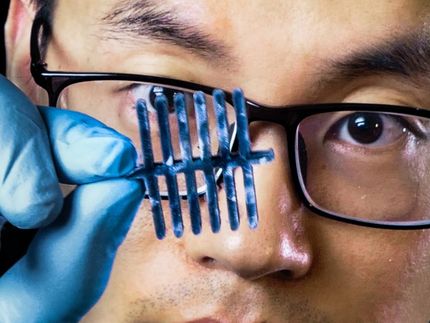
Scientists at the Laboratory of Organic Electronics have developed an ultra-sensitive heat sensor that is flexible, transparent and printable. The results have potential for a wide range of applications - from wound healing and electronic skin to smart buildings.

Research fellow Dan Zhao with the printable ultra-senstive sensor.
Peter Holgersson
The ultra-sensitive heat sensor is based on the fact that certain materials are thermoelectric. The electrons in a thermoelectric material move from the cold side to the warm side when a temperature difference arises between the two sides, and a voltage difference arises. In this present project, however, the researchers have developed a thermoelectric material that uses ions as charge carriers instead of electrons, and the effect is a hundred times larger.
A thermoelectric material that uses electrons can develop 100 μV/K (microvolt per Kelvin), which is to be compared with 10 mV/K from the new material. The signal is thus 100 times stronger, and a small temperature difference gives a strong signal.
The results from the research, carried out by scientists at the Laboratory of Organic Electronics at Linköping University, Chalmers University of Technology, Stuttgart Media University and the University of Kentucky, have been published in Nature Communications.
Dan Zhao, research fellow at Linköping University and one of three principal authors of the article, has discovered the new material, an electrolyte that consists of a gel of several ionic polymers. Some of the components are polymers of p-type, in which positively charged ions carry the current. Such polymers are well-known from previous work. However, she has also found a highly conductive polymer gel of n-type, in which negatively charged ions carry the current. Very few such materials have been available until now.
With the aid of previous results from work with electrolytes for printed electronics, the researchers have now developed the first printed thermoelectric module in the world to use ions as charge carriers. The module consists of linked n- and p-legs, where the number of leg connections determines how strong a signal is produced. The scientists have used screen printing to manufacture a highly sensitive heat sensor, based on the different and complementary polymers. The heat sensor has the ability that convert a tiny temperature difference to a strong signal: a module with 36 connected legs gives 0.333 V for a temperature difference of 1 K.
"The material is transparent, soft and flexible and can be used in a highly sensitive product that can be printed and in this way used on large surfaces. Applications are found within wound healing, where a bandage that shows the progress of the healing process is used, and for electronic skin", says Dan Zhao.
Another possible application is in temperature exchange in smart buildings.
Original publication

Other news from the department science









These products might interest you

Most read news




More news from our other portals


















Last viewed contents
New NMR method enables monitoring of chemical reactions in metal containers - Analysis of heterogeneous samples in metal containers using zero- to ultralow-field NMR spectroscopy

BioFluidix wins STEP award
Watching complex molecules at work
GE Healthcare and BAC start collaboration in biopharmaceutical purification
Oxford Medical Diagnostics and Michell Instruments launch gas analysis partnership - Oxford Medical Diagnostics and Michell Instruments will jointly develop new industrial gas detection and measurement devices for a number of industrial applications
Wiley InterScience Launches the Analytical Sciences Backfile Collection
Eurofins expands food and feed testing business in the US
QIAGEN launches coronavirus test kit in Germany following derogation by BfArM
Unexpected flexibility found in odorant molecules - High resolution rotational spectroscopy reveals an unprecedented number of conformations of an odorant molecule – a new world record!

How environmental changes affect the shapes of RNA in living cells - Results raises the possibility that we may use this knowledge to fine-tune crops or develop RNA-based therapies for diseases such as COVID-19
New analysis of the structure of silks explains paradox of super-strength - Could lead to even stronger synthetic materials