Opto-electronic nose sniffs out toxic gases
Imagine a polka-dotted postage stamp that can sniff out poisonous gases or deadly toxins simply by changing colors. As reported in Nature chemistry, Kenneth Suslick and his team at the University of Illinois have developed an artificial nose for the general detection of toxic industrial chemicals (TICs) that is simple, fast and inexpensive – and works by visualizing odors. This sensor array could be useful in detecting high exposures to chemicals that pose serious health risks in the workplace or through accidental exposure.
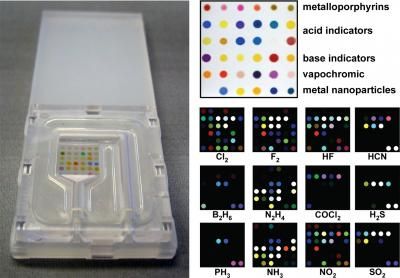
The device uses a printed array smaller than a postage stamp made up of nanoporous pigments that change color in response to their chemical environment. The color differences are shown for a few representative poison gases
Photo courtesy of Kenneth Suslick, University of Illinois.
"Our device is simply a digital multidimensional extension of litmus paper. We have a six by six array of different nanoporous pigments whose colors change depending on their chemical environment," said Suslick, the Schmidt Professor of Chemistry at the U. of I. "The pattern of the color change is a unique molecular fingerprint for any toxic gas and also tells us its concentration. By comparing that pattern to a library of color fingerprints, we can identify and quantify the TICs in a matter of seconds."
To create the sensor array, the researchers print a series of tiny colored dots – each a different pigment – on an inert backing such as paper, plastic or glass. The array is then digitally imaged with an ordinary flatbed scanner or an inexpensive electronic camera before and after exposure to an odor-producing substance. And, unlike other electronic-nose technologies that have been tried in the past, these colorimetric sensors are not affected by changes in relative humidity.
While physicists have radiation badges to protect them in the workplace, chemists and workers who handle chemicals have no good equivalent to monitor their exposure to potentially toxic chemicals. This project, which was funded by the National Institute of Environmental Health Sciences at the National Institutes of Health, exemplifies the types of sensors that are being developed as part of the NIH Genes, Environment and Health Initiative.
To test the application of their color sensor array, the researchers chose 19 representative examples of toxic industrial chemicals. Chemicals such as ammonia, chlorine, nitric acid and sulfur dioxide at concentrations known to be immediately dangerous to life or health were included.
The laboratory studies used inexpensive flatbed scanners for imaging. The researchers have developed a fully functional prototype handheld device that uses inexpensive white LED illumination and an ordinary camera, which will make the whole process of scanning more sensitive, smaller, faster, and even less expensive. It will be similar to a card-scanning device. The device is now being commercialized by iSense, located in Palo Alto, Calif., and Champaign.
Other news from the department science







Most read news




More news from our other portals
















Last viewed contents
ORNL scientists help explain graphene mystery
Altmann Analytik acquires lab supplier Dinkelberg analytics
New organ-on-chip pilot seeks to reduce animal testing in consumer health industry - Cooperation between Bayer, the start-ups esqLABS and Dynamic42, and Placenta Lab of Jena University Hospital
New method provides more precise information on types of leukaemia - Optical genome mapping could become a component of routine diagnostics
Oxford Nanopore Announces Licence Agreement with Harvard University for Graphene DNA sequencing

Waters and BD's Biosciences & Diagnostic Solutions Business to Combine - Creating a Life Science and Diagnostics Leader Focused on Regulated, High-Volume Testing

World's first toxicology testing strategy without animal testing adopted by OECD - Success for long-standing collaboration between BASF and Givaudan to develop and validate alternative methods
Three Eyes See More than Two - monitoring a catalytic reaction with three different microscopies under exactly the same conditions in real time - Information is obtained that none of the methods alone could reveal

(How) Cells Talk to Each Other - ISTA Scientists Successfully Model Cell Dynamics
NIST sensor improvement brings analysis method into mainstream
Tracking of individual catalyst nanoparticles during heating