AI-based support system for skin cancer diagnostics explains its decisions
The explanations increased doctors' confidence in the machine's decisions - as well as in their own diagnoses
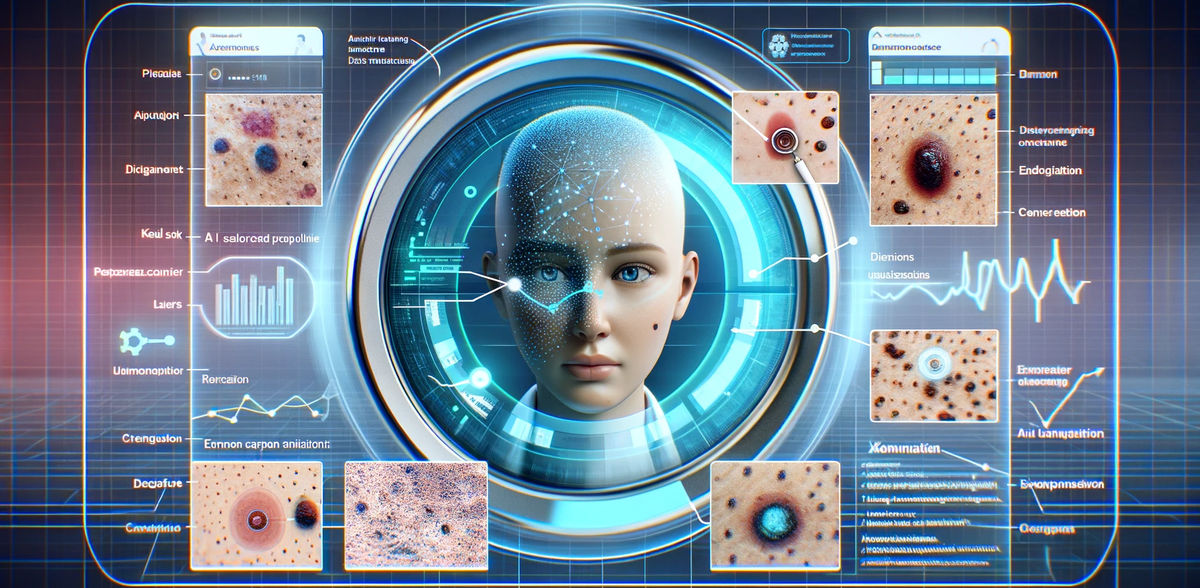
artificial intelligence (AI) can help dermatologists to detect skin cancer. However, many dermatologists distrust the algorithms' decisions, which they cannot comprehend. Scientists at the German cancer Research Center have now developed an AI-based support system for skin cancer diagnostics that explains its decisions. The system uses established diagnostic features that relate to specific areas of suspicious lesions. The explanations increased doctors' confidence in the machine's decisions - as well as in their own diagnoses.
Melanoma is responsible for the majority of skin cancer-related deaths worldwide. However, early-stage melanomas are difficult to distinguish from other skin tumors. Recent advances in artificial intelligence-based diagnostic support systems can help dermatologists diagnose melanomas and moles more accurately when they are shown digitized images of suspicious lesions.
However, doctors want to understand which features determine the outcome of an AI support system. "The ultimate responsibility for a diagnosis lies with the clinician. That's why dermatologists are justifiably cautious about using AI-based systems without being able to understand their decisions," says Titus Brinker, dermatologist and scientist at the DKFZ. But the systems tend to include all correlated features in their decision-making, including spurious correlations.

"Our aim was therefore to develop a support system that is tailored to the way dermatologists view melanoma diagnosis and explains their decision-making," says Brinker. "Following previous work, we developed our explainable AI (XAI = explainable artificial intelligence) to provide dermatologist-like explanations based on the characteristics of specific, individual zones of the lesion."
In a three-phase study, Brinker's team investigated the effects on diagnostic accuracy, diagnostic confidence and dermatologists' trust in the explanatory system. The researchers also wanted to know which factors promote doctors' confidence in this technique.
Over one hundred dermatologists from 33 different countries took part in the study. The doctors diagnosed a test panel of digitized images of various lesions three times - based on their experience alone, with the support of a conventional AI system and with the XAI.
As documented in previous studies, the use of an AI system increased diagnostic accuracy in the detection of melanoma, but this could not be further increased by using the XAI. Dermatologists' confidence in their own decisions also improved with AI support - and increased significantly once again when using the XAI system. The doctors had particular confidence in their own diagnosis when their decision criteria largely matched the criteria listed by the XAI.
The results illustrate that the XAI can improve the diagnostic confidence of clinicians and has the potential to increase the acceptance of AI methods among medical professionals," explains Titus Brinker, head of the study, adding: "The European General Data Protection Regulation requires that all algorithm-based decisions must be interpretable for users. Our work is an important first step towards closing the interpretation gap."
Tirtha Chanda, Katja Hauser, Sarah Hobelsberger, Tabea-Clara Buche, Carina Nogueira Garcia, Christoph Wies, Harald Kittler, Philipp Tschandl, Cristian Navarrete-Dechent, Sebastian Podlipnik, Emmanouil Chousakos, Iva Crnaric, Jovana Majstorovic, Linda Alhajwan, Tanya Foreman, Sandra Peternel, Sergei Sarap, İrem Özdemir, Raymond L. Barnhill, Mar Llamas Velasco, Gabriela Poch, Sören Korsing, Wiebke Sondermann, Frank Friedrich Gellrich, Markus V. Heppt, Michael Erdmann, Sebastian Haferkamp, Konstantin Drexler, Matthias Goebeler, Bastian Schilling, Jochen S. Utikal, Kamran Ghoreschi, Stefan Fröhling, Eva Krieghoff-Henning, Titus J. Brinker: Dermatologist-like explainable AI enhances trust and confidence in diagnosing melanoma.
Original publication
Other news from the department science