Virtual exploration of chemical reactions
A new online platform for exploring computationally calculated chemical pathways, enabling in-depth understanding and design of chemical reactions

Advances in computational chemistry have proven a great boon in the field of reaction design, leading to the discovery of new reaction pathways for the synthesis of high-value compounds. Computational chemistry generates much data, and the process of organizing and visualizing this data is vital to be able to utilize it for future research.
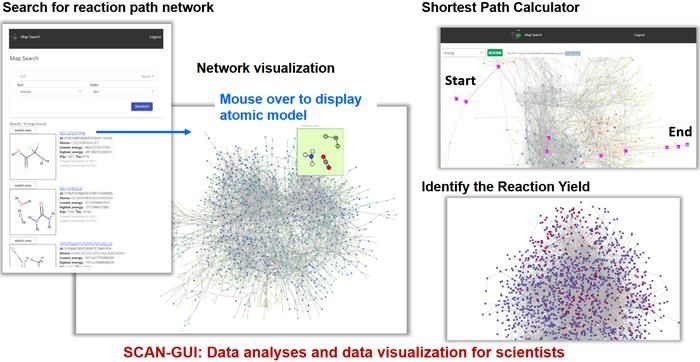
Searching Chemical Action and Network (SCAN) has a graphical user interface (GUI) that can be used for data analyses and data visualization.
Keisuke Takahashi
A team of researchers from Hokkaido University, led by Professor Keisuke Takahashi at the Faculty of Chemistry and Professor Satoshi Maeda at the Institute for Chemical Reaction Design and Discovery (WPI-ICReDD), have developed a centralized, interactive, and user-friendly platform, Searching Chemical Action and Network (SCAN), to explore reaction pathways generated by computational chemistry. Their research was published in the journal Digital Discovery.
“From a computational viewpoint, chemical reactions can be considered as extremely complex networks that consist of numerous molecular interactions,” explains Takahashi. “Many tools have been developed to calculate these networks, such as the AFIR method we use at WPI-ICReDD. However, tools to explore these calculated networks are also needed, which led us to the current study.”
In broad strokes, all the raw data from AFIR calculations form a “data lake.” This data is then subjected to a pre-processing step, creating a “data warehouse.” Finally, the “data mart” accesses and retrieves data from the data warehouse and provides tools to visualize, analyze, and share the retrieved data.
“The pre-processing step is crucial,” Maeda elaborates. “The raw data form AFIR contains an immense amount of information, from which the key data required for the SCAN platform must be extracted. This key data is sufficient to allow the creation of an interactive reaction pathway map which can be searched and viewed.”
SCAN is accessible on the internet. The source code for SCAN is also publicly available.
“We have developed SCAN with a user-friendly graphic user interface,” concludes Takahashi. “Users can search and explore the chemical reaction path network generated by the first principle calculation (AFIR). It will aid in achieving a detailed understanding of complex chemical reaction pathways.”
Original publication
Mikael Kuwahara, et al. Searching Chemical Action and Network (SCAN): Interactive Chemical Reaction Path Network Platform. Digital Discovery. July 5, 2023
Other news from the department science














Most read news






More news from our other portals



























Last viewed contents
MedMira Completes Acquisition of SensorChem

A silk coat for diamonds
Icy exposure creates armored polymer high tech foams
Caltech chemists say antibody surrogates are just a 'click' away
Thermo Fisher Scientific Expands Shanghai Production Capacity - First global company to locally produce cell culture products in China for China
Twisting laser light offers the chance to probe the nano-scale - New method to sensitively measure the structure of molecules
Carl Zeiss wins G.I.T. InnovationsAward 2012 for AURIGA Laser
Eppendorf Young Investigator Award 2008 for Dr. Simon Boulton - Groundbreaking work on SPAR1, a newly discovered helicase
Light and nanoprobes detect early signs of infection