3D internal structure of rechargeable batteries revealed for the first time
Lancaster University researchers have pioneered a technique to observe the 3D internal structure of rechargeable batteries for the first time.

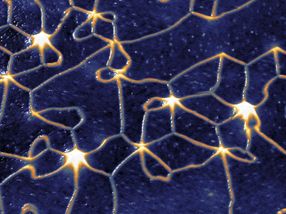
Symbolic image
Computer-generated image
The research, published in Nature Communications, is led by Professor Oleg Kolosov from Lancaster’s Physics Department in collaboration with University College London and NEXGENNA Faraday Institution Consortium.
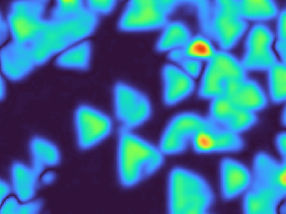
The team used a novel 3D Nano-Rheology Microscopy (3DNRM) -based technique to visualise the 3D nanostructure inside rechargeable batteries, from the molecular scale electrical double-layer to the nanoscale-thick electrochemical surface layer on the graphite anode surface in a lithium-ion battery.
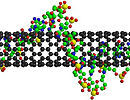
For the first time, this enabled the direct observation of the progression of the whole three dimensional structure of the solid electric interface (SEI), a nanoscale passivation layer formed on the battery electrode-electrolyte interface, that predetermines key battery properties.
The authors were able to reveal key predictors of SEI layer formation in a complex interplay of molecular dimension electrical double layer structures, surface properties of carbon layers and solvent - Li ions interaction in the electrolyte.
The nanoarchitecture of solid-liquid interfaces are critical for high performance batteries, but it has been difficult to characterise reaction interfaces within batteries due to their inherent inaccessibility.
Dr Yue Chen of Lancaster University, who is the lead author, said: “So far, understanding the SEI formation mechanism is still a most challenging and least explored area due to the lack of an interfacial characterization technique capable of both nanoscale resolution and operation in the working battery environment.”
The dynamics of interfacial reactions define energy flow and conversion and govern chemical species transfer in important physical, chemical and biological processes, from catalytic reactions, energy storage and release in batteries, to antigen-antibody interactions and information transmission across neural cells.
This opens up a wide range of areas for the new technique from energy storage and chemical engineering to biomedical applications.
Other news from the department science