Antibiotic resistance testing no longer impeded by time
Researchers have developed a novel method for antibiotic resistance testing that might transform microbial screening in clinical and research labs
Significant time is needed to determine the drug susceptibility profile of a bacterial infection. Now, researchers from Nara Institute of Science and Technology and collaborating partners have published reports on a technology that will dramatically speed up this otherwise slow process and possibly help save lives.
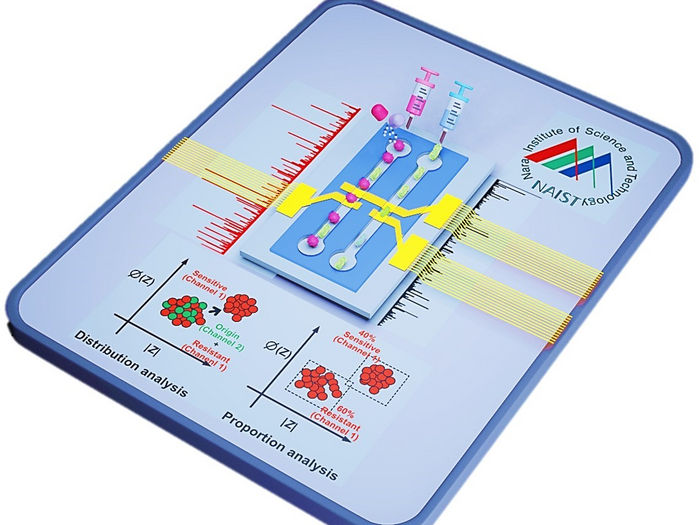
Schematic of the intelligent impedance system, consisting of a parallel impedance cytometry and a machine learning-based detection system. In the case of single bacteria detection, untreated bacteria cells were measured in one channel as the reference, and antibiotic-treated cells were measured in another channel as the target particles. The lab-made lock-in amplifier measured the impedance of single cells in both channels, and sent all signals to the computer, where an intelligent system analyzed the signals in real time. The intelligent system was able to show the impedance waveforms, extract impedance magnitudes and phases, recognize susceptible cells in real time and display the result directly.
Yaxiaer Yalikun
The U.S. CDC states that antibiotic-resistant infections are responsible for killing over a million people worldwide every year. Central to managing resistant infections is quickly identifying an appropriate treatment to which the infective bacteria are susceptible. "Oftentimes susceptibility results are needed much faster than conventional tests can deliver them," says Yaxiaer Yalikun, senior author. "To address this, we developed a technology that can meet this need."
The group’s work is based on impedance cytometry which measures the dielectric properties of individual cells with high throughput – over a thousand cells per minute. Because the electrical readout of a bacterium corresponds to its physical response to an antibiotic, one has a straightforward means of determining whether the antibiotic works against the bacteria. Conventional impedance cytometry involves analyzing the test (antibiotic treated) and reference (untreated) particles in one sample followed by calibrating the impedance of the two particles – both steps require technical specialists to carry out extensive post-processing, which was a major limitation the group was determined to overcome.
In a study published in ACS Sensors, the group develops a novel impedance cytometry method that simultaneously analyses the test and reference particles in separate channels, creating easily analyzable separate datasets. This cytometry had nanoscale sensitivity, allowing for detection of even minute physical changes in bacterial cells. In a concurrent study published in Sensors and Actuators B, the group designed a machine learning tool to analyze the impedance cytometry data. Because the new cytometry method splits the test and reference datasets, the machine learning tool could automatically label the reference dataset as the “learning” dataset and use it to learn the characteristics of an untreated bacterium. By real-time comparison with antibiotic-treated cells, the tool can identify whether the bacteria are susceptible to the drug and can even identify what proportion of bacterial cells are resistant in a mixed-resistance population. "Although there was a misidentification error of less than 10% in our work, there was a clear discrimination between susceptible and resistant cells within 2 hours of antibiotic treatment," explains Yoichiroh Hosokawa, another senior author in the group.
This work is not limited to rapid evaluations of infections in clinical settings. For example, drug discovery researchers could use it to conduct quick initial investigations of drug efficacy against any cell, as long as the cellular response results in a change in dielectric properties. Impedance cytometry might become a staple of clinical and research labs in the coming years.
Original publication
Other news from the department science









Most read news






More news from our other portals


















See the theme worlds for related content
Topic World Cell Analysis
Cell analyse advanced method allows us to explore and understand cells in their many facets. From single cell analysis to flow cytometry and imaging technology, cell analysis provides us with valuable insights into the structure, function and interaction of cells. Whether in medicine, biological research or pharmacology, cell analysis is revolutionizing our understanding of disease, development and treatment options.
Topic World Cell Analysis
Cell analyse advanced method allows us to explore and understand cells in their many facets. From single cell analysis to flow cytometry and imaging technology, cell analysis provides us with valuable insights into the structure, function and interaction of cells. Whether in medicine, biological research or pharmacology, cell analysis is revolutionizing our understanding of disease, development and treatment options.