New device can measure toxic lead within minutes
Researchers create portable lab-on-a-chip that could detect many contaminants
Rutgers researchers have created a miniature device for measuring trace levels of toxic lead in sediments at the bottom of harbors, rivers and other waterways within minutes - far faster than currently available laboratory-based tests, which take days.
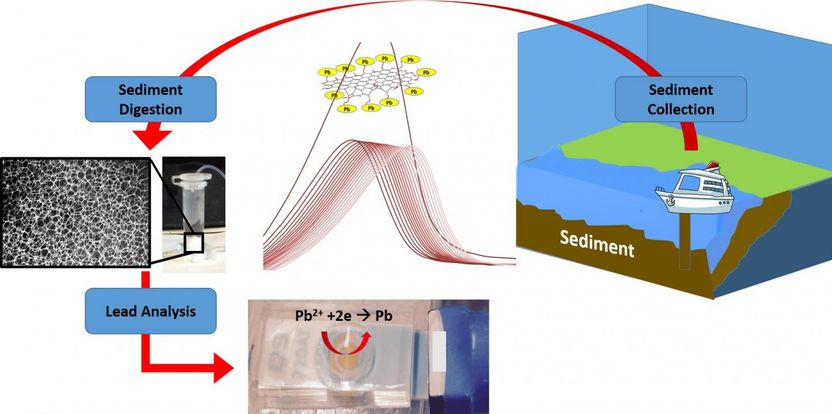
Sediments collected by a ship can be rapidly tested for toxic lead with a new portable lab-on-a-chip device. The miniature device extracts lead from a sample and purifies it, using graphene oxide as a lead detector.
Azam Gholizadeh
The affordable lab-on-a-chip device could also allow municipalities, water companies, universities, K-12 schools, daycares and homeowners to easily and swiftly test their water supplies.
"In addition to detecting lead contamination in environmental samples or water in pipes in homes or elementary schools, with a tool like this, someday you could go to a sushi bar and check whether the fish you ordered has lead or mercury in it," said senior author Mehdi Javanmard, an associate professor in the Department of Electrical and Computer Engineering in the School of Engineering at Rutgers University-New Brunswick.
"Detecting toxic metals like lead, mercury and copper normally requires collecting samples and sending them to a lab for costly analysis, with results returned in days," Javanmard said. "Our goal was to bypass this process and build a sensitive, inexpensive device that can easily be carried around and analyze samples on-site within minutes to rapidly identify hot spots of contamination."
The research focused on analyzing lead in sediment samples. Many river sediments in New Jersey and nationwide are contaminated by industrial and other waste dumped decades ago. Proper management of contaminated dredged materials from navigational channels is important to limit potential impacts on wildlife, agriculture, plants and food supplies. Quick identification of contaminated areas could enable timely and cost-effective programs to manage dredged materials.
The new device extracts lead from a sediment sample and purifies it, with a thin film of graphene oxide as a lead detector. Graphene is an atom thick layer of graphite, the writing material in pencils.
More research is needed to further validate the device's performance and increase its durability so it can become a viable commercial product, possibly in two to four years.
Original publication
Other news from the department science











Most read news





More news from our other portals















Last viewed contents
Thermo Fisher Scientific and NETZSCH-Gerätebau Announce Sales Cooperation Agreement

Name that Scotch - Colorimetric recognition of aldehydes and ketones

Brain modulyzer provides interactive window into the brain
Oxford Gene Technology grants microarray license to NGK Insulators Ltd.
Lab21 Wins Biomedical Project of the Year Award
New method for the measurement of nano-structured light fields - Researchers combine nano-optics and organic chemistry to measure complex light landscapes in the tight focus of a laser beam
ultraWAVE 3 | Microwave acid digestion systems | Milestone

Oscillating Ions imitate optical Laser - MPQ/Caltech scientists demonstrate mechanical analogue to an optical laser with single ions
Novel sensor implant radically improves significance of NMR brain scans - Researchers present a new method that shows single neuron data
Corning Completes BD Discovery Labware Business Acquisition - Broadens Life Sciences product portfolio and geographic reach
Infrared light to detect early signs of esophageal cancer