Musical sensor shows bad medicine plays false note
Inspired by a musical instrument, the simple sensor can be constructed from common materials and used to detect adulterated or counterfeit drugs
What if a single musical note could mean the difference between life and death?
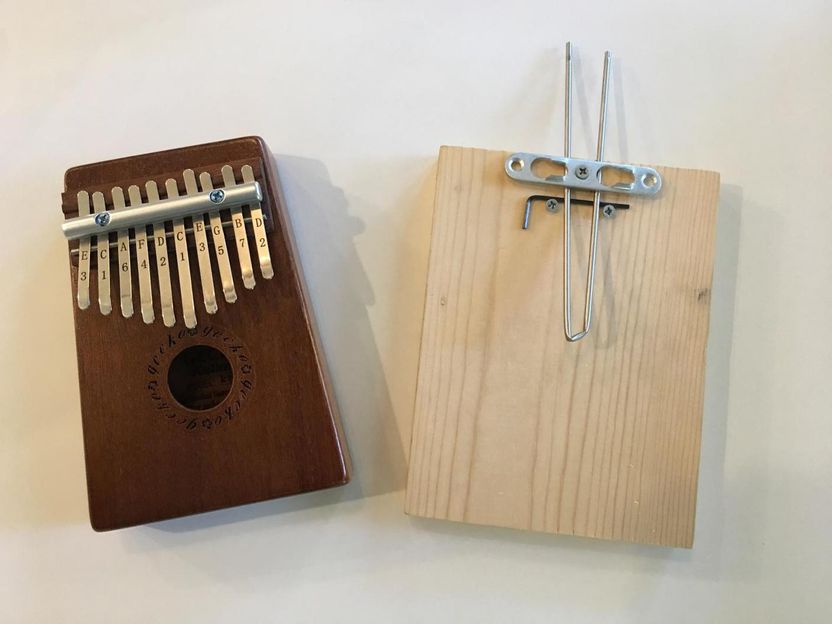
Mbira instrument next to a density sensor based on it.
William Grover
A new sensor based on a 3,000 year old African musical instrument can be used to identify substances, including a poisonous chemical sometimes mistakenly added to medicines. The mbira sensor, which can be constructed from off-the-shelf or discarded materials, could offer pharmacists and consumers in the developing world inexpensive protection from counterfeit and adulterated drugs.
The World Health Organization estimates that 10 percent of all medicines in low- and middle- income countries are counterfeit. Existing technologies to identify counterfeit drugs are both expensive and require expert technicians, neither of which are readily available in much of the developing world.

The device, built by an engineer at the University of California, Riverside, and described in a paper published in ACS Omega, can accurately measure the density of any liquid. Comparing the density of a suspicious liquid medicine to the density of the known product can reveal whether or not the two medicines have the same ingredients.
The research was inspired by the observation that frequencies of sound created by a musical instrument are determined by the instrument's physical properties. For example, the pitch of a guitar string is a function of the length and tension of the string.
"Could we add a sample to a musical instrument, measure the resulting change in the instrument's notes, and use this change to determine information about the sample and its properties?" asked William Grover, an assistant professor of bioengineering in UCR's Marlan and Rosemary Bourns College of Engineering.
To find out, Grover and his team modified a mbira, or kalimba, a musical instrument originating in Africa made of graduated metal prongs attached to a soundboard. The prongs play different musical notes when plucked with the finger. By replacing the metal prongs with a length of bent metal tubing and injecting it with a liquid, Grover compared the frequency of the musical notes made by the filled and empty tube to measure the liquid's density. Empty, the tube played a G sharp note; when filled with water, it played an F sharp.
With scrap wood and tubing he found in his garage, Grover built a new device from scratch. Experiments determined the optimal mbira sensor tube had thin walls and a length no shorter than 50 millimeters. His students used the device to measure the density of everything from local river water to buffalo milk in India, but they soon settled on detecting dangerous medicines as the ideal first application for their sensor.
One adulterant sometimes found in counterfeit cold medicines is diethylene glycol, a poison that looks, tastes, and smells like glycerol, a syrup that carries the active ingredients in many cold and flu medicines. Since 1985, a fatal mass poisoning caused by medicine containing diethylene glycol has occurred somewhere in the world on average every two years, with a combined death toll in the hundreds. An inexpensive sensor usable by both experts and consumers would save lives.
The researchers first confirmed their mbira sensor could tell the difference between harmless glycerol and deadly diethylene glycol. After filling the sensor with each substance, recording its musical notes using a smartphone, and uploading the recordings to an analysis website they created, they found that glycerol and diethylene glycol make notes whose frequencies differ by 10 hertz.
This is too small a difference to notice by ear, but it's easily detectible by the website's software. It shows that someone using the mbira sensor and a smartphone could easily distinguish these two substances.
The researchers then tested six different batches of a popular cold and flu medicine purchased from various pharmacies in the Riverside area. All of the samples made the same musical note when loaded into the sensor. This suggests the medicine samples were identical and authentic, and that any sample of the drug making a different musical note must be chemically different from the authentic drug and may be counterfeit or adulterated.
The sensor could help drug companies or compounding pharmacists in the developing world verify bottles of glycerol that might have been mislabeled, unintentionally or not, by the manufacturer or distributor. It can also help consumers detect counterfeit drugs by comparing the density of a suspect sample to a known good sample of the same drug.
Measuring density as a musical note also presents the surprising possibility to write the frequency using musical notation easily interpreted by anyone who can read music, with little to no scientific training. For this reason, the authors included musical notation versions of the density measurements in the paper.

Other news from the department science











Most read news






More news from our other portals



















Last viewed contents
PerkinElmer and University of Copenhagen Announce Licensing Agreement for New Maternal Health Marker ADAM12
How can we fight blood cancer more effectively? - Several hundred different treatment combinations to be tested simultaneously outside the body
LGC announces plans to expand forensic services with new facilities to be created in Runcorn, Cheshire
Synthetic Production of Potential Pharmaceuticals Dramatically Simplified by Scripps Research Team - Findings Could Expand Interest in Natural Products by Making Production More Cost-Effective
Light-induced shape shifting of MXenes - Femtosecond light creates switchable nano-waves in MXenes and moves the materials’ atoms at a record-breaking speed
Brooks Instrument Joins Major Biotechnology Consortium Focused on Regenerative Drug Manufacturing - Brooks Instrument will contribute insights and precision fluid control technology to the Advanced Regenerative Manufacturing Institute’s BioFabUSA program
Promising discovery for a non-invasive early detection of Alzheimer's disease
Innovations through hair-thin optical fibres - Study shows what miniaturised optical filters make possible
Wave of the future - Terahertz chips a new way of seeing through matter

Using PETRA III to watch the disabling of a penicillin killer - Scientists observe in detail the binding and formation of covalent bonds of an inhibitor to a bacterial enzyme that disables common antibiotics
Eurofins acquires LGC Forensics