Measurement of the dynamic mechanical properties of viscous materials

DIN standard for the determination of the tip radius and the probing force of stylus instruments developed

07-Jun-2016 - Germany

In microsystems metallic components are increasingly being replaced by those from low-cost polymers. For the thickness measurement of polymers, there is now the DIN standard 32567 available, which describes both, optical and tactile surface measuring methods for the precise measurement of the thickness of polymer layers. The standard describes methods by which both, the contact force and the tip radius of stylus instruments can be measured, a basic condition for non-destructive precision tactile profile measurements.

From motion sensor to smartphones - many everyday products increasingly contain parts which are made of polymer materials. The desired operation of these components depends not only on the dimensions, often also on the mechanical properties of these materials. The dimensions can be measured optically or tactilely. However, in the thickness measurement of transparent materials with optical measuring methods, but also in the stylus measurement of coatings on hard substrates systematic deviations of the measured thickness are observed. In tactile methods, the main influencing factors are the probing force and the tip radius. With viscous materials whose mechanical properties are time-dependent, also different scanning speeds affect the level of systematic deviations. PTB has therefore, in cooperation with other European national metrology institutes, developed a method for correcting these systematic errors, which has been standardized in DIN 32567. In the standard, the main influencing factors are shown for tactile and optical measurements and methods for the estimation, correction and reduction of systematic errors are described.
PTB

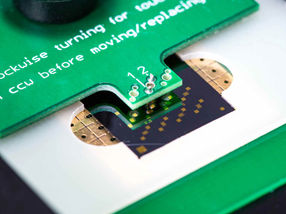
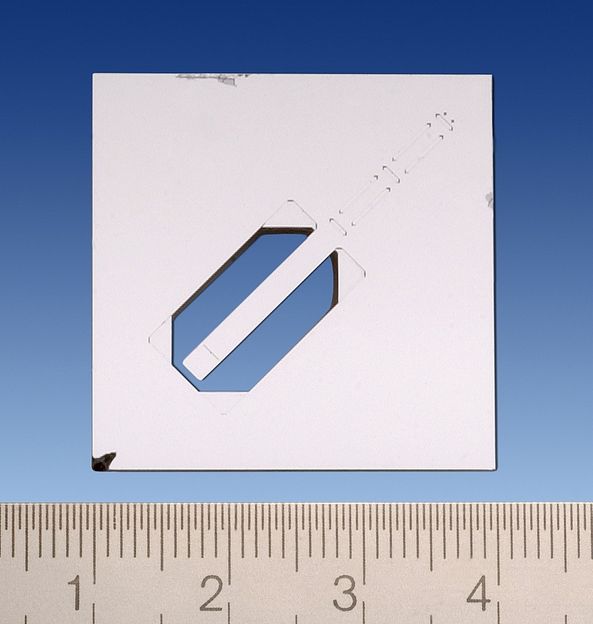
Reference cantilever made of silicon for determining the probing force of contact stylus instruments. From the bending of the beam at the end mark, the contact force is determined.

Original publication

Other news from the department research and development
Most read news

More news from our other portals

Last viewed contents

How to save energy in the laboratory - Electricity Saving Challenge: Exploring savings potential in the laboratory

How to save energy in the laboratory - Electricity Saving Challenge: Exploring savings potential in the laboratory

Using metabolomics for assessing safety of chemicals may reduce the use of lab rats - "We hope that learnings from this research will be included in new guidance for the chemical industry to allow commercial laboratories to provide these services widely"

Using metabolomics for assessing safety of chemicals may reduce the use of lab rats - "We hope that learnings from this research will be included in new guidance for the chemical industry to allow commercial laboratories to provide these services widely"

Atomic structure of a staphylococcal bacteriophage using cryo-electron microscopy exposed

Atomic structure of a staphylococcal bacteriophage using cryo-electron microscopy exposed

Using AI to identify genetic perturbations from cell images - Newly founded start-up aims to use findings to treat previously incurable fibrosis

Using AI to identify genetic perturbations from cell images - Newly founded start-up aims to use findings to treat previously incurable fibrosis

Design organoids with light - Organoids help researchers understand biological processes in health and disease

Design organoids with light - Organoids help researchers understand biological processes in health and disease

Munich-based lab automation startup raised €2.77M - AI-driven biotech research: Connected labs for faster scientific progress

Munich-based lab automation startup raised €2.77M - AI-driven biotech research: Connected labs for faster scientific progress

ECHA calls for information to avoid unneccessary animal testing

Diagnostic biosensor quickly detects SARS-CoV-2 from nasopharyngeal swabs - New test analyzes patient samples without any sample preparation steps

Diagnostic biosensor quickly detects SARS-CoV-2 from nasopharyngeal swabs - New test analyzes patient samples without any sample preparation steps

The protective armor of superbug C.difficile revealed - Spectacular structure of chain-mail may explain the success of C.diff at defending itself against antibiotics and immune system molecules

The protective armor of superbug C.difficile revealed - Spectacular structure of chain-mail may explain the success of C.diff at defending itself against antibiotics and immune system molecules

Merck and imec Collaborate to Develop Disruptive Microphysiological Systems Platform - The collaboration programme is open to further partners

Merck and imec Collaborate to Develop Disruptive Microphysiological Systems Platform - The collaboration programme is open to further partners

Ångström-Resolution Fluorescence Microscopy - This innovation is poised to usher in a paradigm shift in our approach to study biological systems with thus far unprecedented detail

Ångström-Resolution Fluorescence Microscopy - This innovation is poised to usher in a paradigm shift in our approach to study biological systems with thus far unprecedented detail

A new way to stimulate cellular recycling process

A new way to stimulate cellular recycling process