Analytik Jena planning merger by absorption of CyBio AG

14-Apr-2014 - Germany

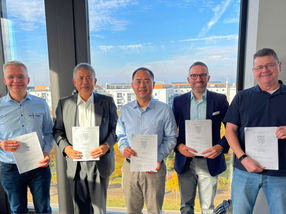
Analytik Jena AG is planning to merge the business of its subsidiary CyBio AG, also headquartered in Jena, with its core business in the Life Science business unit. Against this backdrop, CyBio AG will be merged into Analytik Jena AG during the current financial year. A corresponding merger by absorption agreement was signed this past Friday.

As part of the merger by absorption, Analytik Jena AG plans to acquire all the remaining shares of CyBio AG by means of a method to squeeze out minority shareholders (known as a squeeze-out merger). The shareholders of CyBio AG are to draft a resolution to transfer the shares of the minority shareholders to Analytik Jena AG as the majority shareholder in return for payment of compensation in cash at the Company's General Meeting on May 22, 2014. Analytik Jena AG currently holds 91.9% of the voting rights of CyBio AG.

The business activities of the CyBio Group are to be continued after the merger becomes effective and to be expanded in the coming years. CyBio products and services will continue to be marketed as an independent CyBio product line under the CyBio brand by Analytik Jena AG. CyBio AG currently employs 98 staff members around the world and is fully consolidated in the Analytik Jena Group. Analytik Jena AG already acquired the majority of the shares of CyBio AG in 2009.

"With the strategic and operational realignment of CyBio AG, we have consistently driven business in a customer-oriented way in the areas of liquid handling and laboratory automation technology in the past five years as part of the Analytik Jena Group. CyBio AG has become an integral and successful part of the Analytik Jena AG family," said Klaus Berka, Chief Executive Officer of Analytik Jena AG. "The planned merger and structural integration is the logical continuation of this path with the aim of bundling our competencies in the Group portfolio and thus providing access for our customers to an even more comprehensive range."

Other news from the department business & finance

Most read news

More news from our other portals

Last viewed contents

Plants transformed into detectors of dangerous chemicals - Scientists engineer plants to speak in color

Plants transformed into detectors of dangerous chemicals - Scientists engineer plants to speak in color

New NMR method enables monitoring of chemical reactions in metal containers - Analysis of heterogeneous samples in metal containers using zero- to ultralow-field NMR spectroscopy

New NMR method enables monitoring of chemical reactions in metal containers - Analysis of heterogeneous samples in metal containers using zero- to ultralow-field NMR spectroscopy

BioFluidix wins STEP award

BioFluidix wins STEP award

Watching complex molecules at work

Watching complex molecules at work

GE Healthcare and BAC start collaboration in biopharmaceutical purification

Oxford Medical Diagnostics and Michell Instruments launch gas analysis partnership - Oxford Medical Diagnostics and Michell Instruments will jointly develop new industrial gas detection and measurement devices for a number of industrial applications

Wiley InterScience Launches the Analytical Sciences Backfile Collection

Eurofins expands food and feed testing business in the US

QIAGEN launches coronavirus test kit in Germany following derogation by BfArM

Unexpected flexibility found in odorant molecules - High resolution rotational spectroscopy reveals an unprecedented number of conformations of an odorant molecule – a new world record!

Unexpected flexibility found in odorant molecules - High resolution rotational spectroscopy reveals an unprecedented number of conformations of an odorant molecule – a new world record!

How environmental changes affect the shapes of RNA in living cells - Results raises the possibility that we may use this knowledge to fine-tune crops or develop RNA-based therapies for diseases such as COVID-19

How environmental changes affect the shapes of RNA in living cells - Results raises the possibility that we may use this knowledge to fine-tune crops or develop RNA-based therapies for diseases such as COVID-19

New analysis of the structure of silks explains paradox of super-strength - Could lead to even stronger synthetic materials