Micro-Copier for Genome Analysis
New method holds promise to advance personalised medicine
The scientists Jochen Hoffmann, Dr. Guenther Roth, and Prof. Dr. Roland Zengerle from the Department of Microsystems Engineering (IMTEK) at the University of Freiburg can copy simultaneously 100.000 different DNA sequences in a so called picowell array that has the size of a one cent coin.
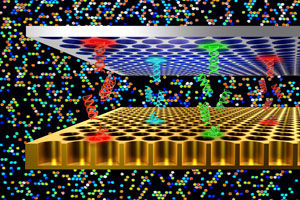
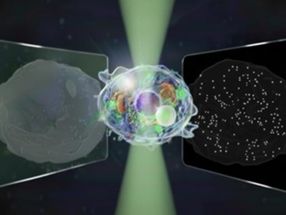
The DNA sequences are replicated in picowell arrays (bottom) and transferred on microscopic slides (top).
IMTEK
The picowell array is a chip with 100.000 wells on which the DNA sequences are dispersed in order to achieve a statistical distribution of one sequence per well. All wells are then covered with one microscopic slide and the DNA sequences are replicated by polymerase chain reaction (PCR) technique. The resulting DNA copies bind to the miscroscopic slide at exactly the position of the original DNA sequence. The DNA copies can be decoded by next-generation sequencing systems in the wells of the array. The microscopic slides can be used, similar to DNA microarrays, for the rapid and cost-effective analysis of entire genomes – without the need for other equipment or additional transfer steps.
Such genome analyses allow insights into the regulatory systems of an organism. For example the genome analysis of a tumour cell can reveal which of its signal paths are defective. This knowledge in the context of “personalised medicine” can help to develop a tailored therapy for a specific patient group.
The project was supported by the “Program for Excellency in Science and Technology” as part of a grant from the Hans L- Merkle-Stiftung. The Robert Bosch GmbH and the Association for the Promotion of Science and Humanities in Germany also supported the project.
The topic is now further developed in the Lab-on-a-Chip research groups “Arrays” of Jochen Hoffmann and “Assays” of Dr. Guenther Roth. Lab-on-a-chip is a main research topic in cooperation with the Laboratory for MEMS Applications and the Institut fuer Mikro- und Informationstechnik der Hahn-Schickard-Gesellschaft (HSG-IMIT). The research groups are based on the campus of the Faculty for Engineering.
Original publication
Other news from the department research and development








Most read news




More news from our other portals















See the theme worlds for related content
Topic World PCR
This groundbreaking and highly versatile molecular technique of PCR allows us to amplify tiny amounts of genetic material on a large scale and analyze them in detail. Whether in medical diagnostics, forensic DNA analysis or research into genetic diseases - PCR is an indispensable tool that gives us deep insights into the world of DNA. Immerse yourself in the fascinating world of the polymerase chain reaction (PCR)!

Topic World PCR
This groundbreaking and highly versatile molecular technique of PCR allows us to amplify tiny amounts of genetic material on a large scale and analyze them in detail. Whether in medical diagnostics, forensic DNA analysis or research into genetic diseases - PCR is an indispensable tool that gives us deep insights into the world of DNA. Immerse yourself in the fascinating world of the polymerase chain reaction (PCR)!
Last viewed contents
Amorfix and Ontario Genomics Institute announce partnership to accelerate development of blood test for Alzheimer's Disease
New Head of Marketing Communications and PR at JULABO

New test improves diagnosis of allergies - Higher diagnostic accuracy than standard tests

HeartBeat.bio raises € 4.5 million in Pre-Series A financing - New funds to drive development of organoid screening platform for cardiac drug discovery
New computer vision system designed to analyse cells in microscopy videos
Musical sensor shows bad medicine plays false note - Inspired by a musical instrument, the simple sensor can be constructed from common materials and used to detect adulterated or counterfeit drugs
PerkinElmer and University of Copenhagen Announce Licensing Agreement for New Maternal Health Marker ADAM12
How can we fight blood cancer more effectively? - Several hundred different treatment combinations to be tested simultaneously outside the body
LGC announces plans to expand forensic services with new facilities to be created in Runcorn, Cheshire
Synthetic Production of Potential Pharmaceuticals Dramatically Simplified by Scripps Research Team - Findings Could Expand Interest in Natural Products by Making Production More Cost-Effective
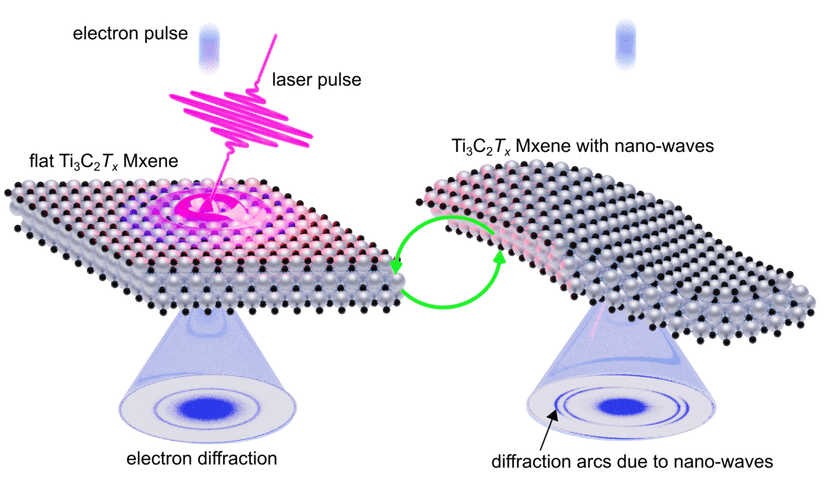
Light-induced shape shifting of MXenes - Femtosecond light creates switchable nano-waves in MXenes and moves the materials’ atoms at a record-breaking speed