BESSY II: Phosphor chains - a 1D material with 1D electronic properties
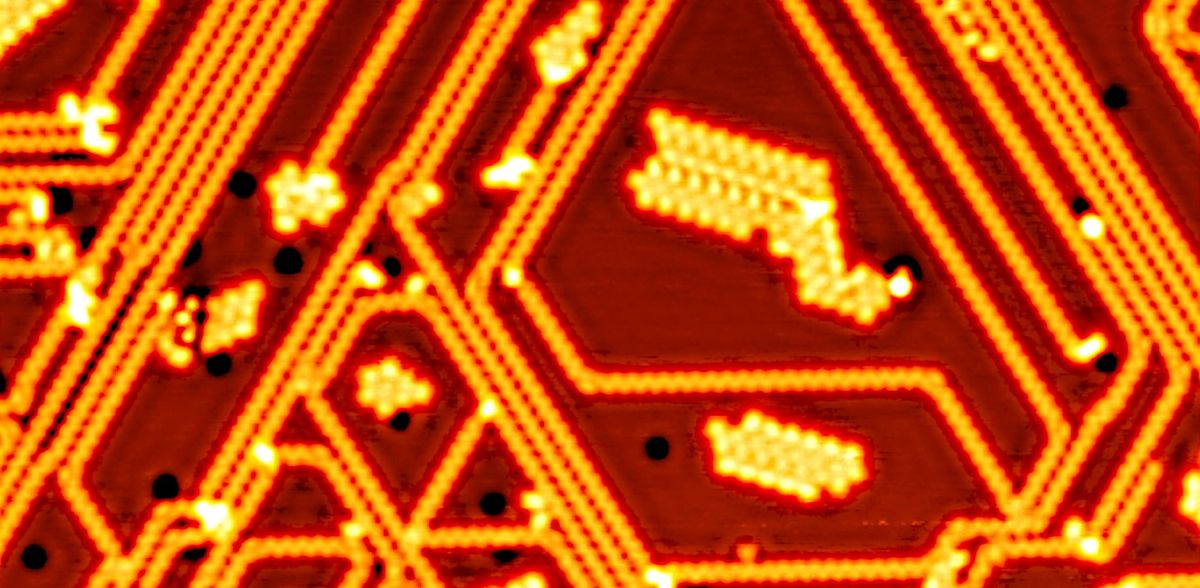
For the first time, BESSY II has succeeded in experimentally demonstrating one-dimensional electronic properties in a material. The samples consisted of short chains of phosphorus atoms that form on a silver substrate in a self-organized manner at specific angles. Using a sophisticated analysis, it was possible to separate the contributions of differently oriented chains and to show that the electronic properties actually have a one-dimensional character. Calculations also showed that an exciting phase transition is to be expected. While the material consisting of individual chains is semiconducting, a very dense chain structure would be metallic.
The material world consists of atoms that combine to form all kinds of different substances. As a rule, these atoms are interconnected both in a plane and perpendicular to it. But there is another way: carbon atoms can form graphene, a hexagonal network in which they are only connected to each other in one plane. The element phosphorus can also cross-link in two dimensions and form a stable 2D shape. Such two-dimensional materials are an exciting field of research because they have amazing electronic and optical properties. Theoretical considerations show that the electro-optical properties of one-dimensional structures could be even more exotic.
In fact, it has recently been possible to produce one-dimensional structures. Under certain conditions, for example, it is possible for phosphorus atoms to arrange themselves into short lines on a silver substrate. Morphologically, these chains are one-dimensional. However, it must be assumed that they interact laterally with other chains. Such interactions influence the electronic structure and could destroy the one-dimensionality. Until now, however, it has not been possible to measure this properly experimentally.
"We have now shown with a very thorough evaluation of measurements at BESSY II that such phosphorus chains really do have a one-dimensional electronic structure," says Prof. Oliver Rader, who heads the Department of Spin and Topology in Quantum Materials at HZB.
Dr. Andrei Varykhalov and his team first produced and characterized phosphor chains on silver using a cryo-scanning tunnelling microscope. The images show that short P-chains form in three different directions on the substrate, with 120-degree angles between them.
"We achieved very high-quality results, for example we were able to observe standing waves (of electrons) forming along the chains on the scanning tunneling microscope," says Varykhalov. They investigated the electronic structure using a method with which the team already has a great deal of experience: Angle-resolved photoelectron emission spectroscopy (ARPES) at BESSY II.
Dr. Maxim Krivenkov and Dr. Maryam Sajedi did pioneering work here: by carefully analyzing the data, they succeeded in separating the contributions from the three differently oriented phosphor chains. "We were able to disentangle the ARPES signals from these domains and thus show that such 1D phosphorus chains actually have a very clear 1D electron structure," says Krivenkov. Calculations using density functional theory confirm this analysis and make an exciting prediction: the closer these chains are to each other, the more strongly they interact. The calculations predict a phase transition from semiconductor to metal as the density of the chain array increases, so that a two-dimensional phosphorus chain structure would be metallic.
"We have entered a new field of research here, uncharted territory in which many exciting discoveries are probably still possible," says Varykhalov.
Note: This article has been translated using a computer system without human intervention. LUMITOS offers these automatic translations to present a wider range of current news. Since this article has been translated with automatic translation, it is possible that it contains errors in vocabulary, syntax or grammar. The original article in German can be found here.
Original publication
Other news from the department science











Most read news




More news from our other portals



















Last viewed contents

StratifAI Raises €12.5M for Clinical Validation of AI Biomarker Platform for Precision Oncology - Oversubscribed round expand global reach, and unlock multi‑billion‑euro cancer diagnostics market

"A DNA search engine" searches through millions of data records in seconds - This can significantly accelerate research into antibiotic resistance and unknown pathogens
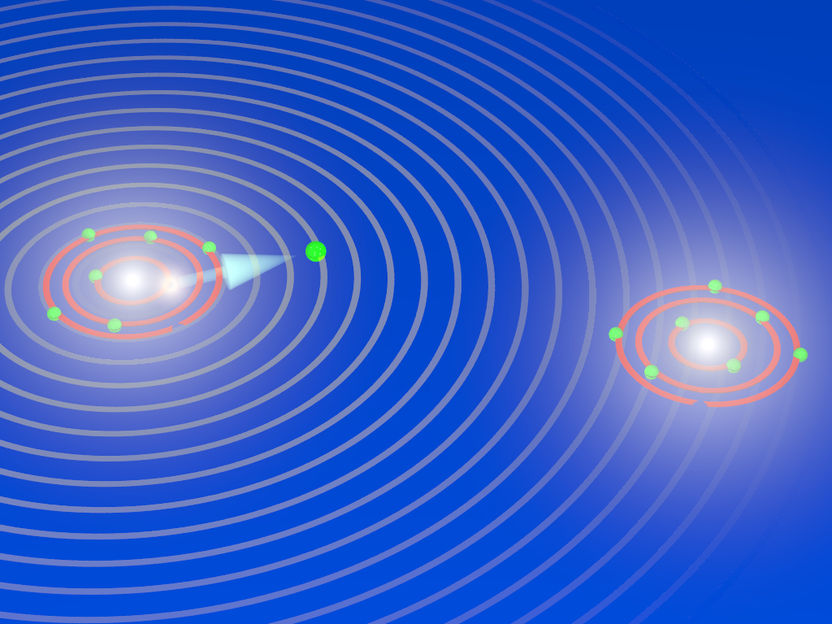
Snapshot of exploding oxygen - New experimental technique with reaction microscope allows “X-ray” of individual molecules

Fast, Easy and “Green” Analysis of phthalates in polymeric substrates - Introduction of the analytical principle and “Method Map”