Tiny gold probes give scientists a sense of how disease develops
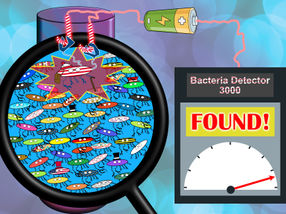
Tiny chemical sensors implanted into patients could help diagnose disease and track its progress, following a development by scientists from the University of Edinburgh. Researchers have developed tiny probes comprising gold-coated particles. These can be inserted into cells, enabling diseases to be detected and monitored remotely using light from a laser.
Once the probe is inside a cell, laser light shone on to it is absorbed then re-emitted, causing nearby proteins in the cell to vibrate according to their shape. Because molecules change shape as disease progresses, they give rise to different vibrational frequencies. Scientists can measure and interpret these vibrations, to understand how the cell is responding to disease.
Gold is used to coat the sensor because it is an unreactive metal, preventing the body from rejecting the implant. The laser technique is highly sensitive, fast and uses a low-power laser.
Scientists say the probes could be a useful tool to learn more about diseases at a very small scale, by observing how molecules interact. Further studies will look at diseases linked to the immune system in the first instance, but researchers say the technique has potential to help doctors diagnose and monitor a range of conditions.
Dr Colin Campbell, who led the research, said: "By creating a sensor that can safely be implanted into tissue and combining this with a sensitive light-measurement technique, we have developed a useful device that will help diagnose and track disease in patients."
The research, funded by the Scottish Universities Physics Alliance, EaSTChem and the Engineering and Physical Sciences Research Council, was published in the journals Chemical Communications.

Other news from the department science















Get the analytics and lab tech industry in your inbox
From now on, don't miss a thing: Our newsletter for analytics and lab technology brings you up to date every Tuesday. The latest industry news, product highlights and innovations - compact and easy to understand in your inbox. Researched by us so you don't have to.