New biosensor can detect bacteria instantaneously
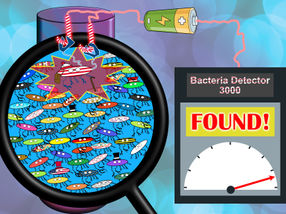
A research group from the Rovira i Virgili University (URV) in Tarragona has developed a biosensor that can immediately detect very low levels of Salmonella typhi , the bacteria that causes typhoid fever. The technique uses carbon nanotubes and synthetic DNA fragments that activate an electric signal when they link up with the pathogen.
"We have developed a new biosensor that can detect extremely low concentrations of bacteria immediately, easily and reliably", F. Xavier Rius, lead author of the study and a professor in the Chemometrics, Qualimetrics and Nanosensors research group in the Analytical Chemistry and Organic Chemistry Department of the URV, tells SINC.
Rius' team, jointly led by Jordi Riu, has come up with a technique that can detect extremely low levels of the bacteria Salmonella typhi , which causes typhoid fever. This new biosensor functions using a method, described in Angewandte Chemie International Edition, which involves carbon nanotubes with inbuilt aptamers providing electrochemical readings.
The aptamers are small fragments of artificial DNA or RNA designed to attach themselves specifically to a particular molecule, cell or micro organism, in this case Salmonella . If the bacteria are not present, the aptamers remain on the walls of the carbon nanotubes. However, if they detect bacteria, they become activated and stick to it, and the carbon nanotubes generate an electric signal that is picked up by a simple potentiometer connected to the biosensor.
"The presence of the bacteria sparks a change in the interaction between the aptamers and the nanotubes, which takes place in a few seconds and creates an increase in the voltage of the electrode", says Rius.
Traditional methods for identifying and measuring micro organisms require one or two days' analysis. "This technique means small quantities of micro organisms can be detected simply and practically in real time, just the same as measuring the pH of water", adds the researcher.
This study is part of the international research being carried out to find the most effective and fast ways of detecting all kinds of pathogens. The new biosensor makes it possible to identify a single cell of Salmonella in a five-millilitre sample and can successfully make quantitative measurements of up to 1,000 bacteria per millilitre.
Original publication: Gustavo A. Zelada-Guillén, Jordi Riu, Ali Düzgün, F. Xavier Rius. "Immediate Detection of Living Bacteria at Ultralow Concentrations Using a Carbon Nanotube Based Potentiometric Aptasensor". Angewandte Chemie International Edition 2009.
Other news from the department science







Get the analytics and lab tech industry in your inbox
From now on, don't miss a thing: Our newsletter for analytics and lab technology brings you up to date every Tuesday. The latest industry news, product highlights and innovations - compact and easy to understand in your inbox. Researched by us so you don't have to.