18 Current news of MPI für Quantenoptik

rss

image description
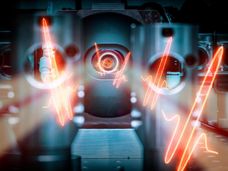
Billard game in an atom

Physicists from the Max Planck Institute of Quantum Optics trace the double ionization of argon atoms on attosecond time scales

05-11-2012

When an intense laser pulse interacts with an atom it generates agitation on the micro scale. A rather likely outcome of this interaction is single ionization, where one electron is ejected from the atom. From time to time, however, two electrons can be removed from the atom, resulting in the ...

more

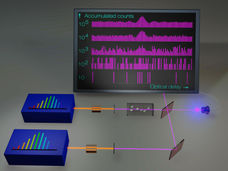
With single laser pulses on single molecules

Physicists at MPQ succeed in resolving the internal dynamics of individual molecules using UV femtosecond laser pulses

02-14-2012

Nowadays, large laser systems provide ultra-short light pulses of very high intensity which – in principle – allow the imaging of matter and its dynamics on atomic scales, down to a single molecule or a virus. However, current methods fall short in efficiency to overlap a target molecule in a ...

more

image description
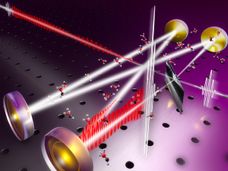
Taming light

White laser pulses with precisely tailored waveform enable the control of electrons in the microcosm

09-12-2011

An expedition through the fast-paced microscopic world of atoms reveals electrons that spin around at enormous speeds and have gigantic forces are acting on them. Monitoring the ultrafast motion of these electrons requires ultrashort flashes of light. However, in order to control them, the ...

more

image description
Snapshots of laser driven electrons

03-17-2011

Physicists of the Laboratory of Attosecond Physics at the Max Planck Institute of Quantum Optics succeeded in the first real-time observation of laser produced electron plasma waves and electron bunches accelerated by them. Flocking behavior does not only exist among birds, insects or ...

more

image description
Attosecond real-time Observation of a Quantum Hole

08-09-2010

For the first time ever, physicists from the Laboratory for Attosecond Physics (LAP) at the Max Planck Institute of Quantum Optics have observed what occurs inside an atom from which a single electron has been ejected. An international team from the Laboratory for Attosecond Physics, led by ...

more

Single atoms for detecting extremely weak forces

MPQ-scientists demonstrate that due to synchronisation atoms can be influenced by forces as weak as 5 yoctonewton

08-06-2010

Back in the 17th century the Dutch physicist Christiaan Huygens made the observation that the oscillation of two pendulums synchronize once they get under mutual influence. This holds for even very loose coupling, for instance, when both pendulums are mounted onto the same wall. ...

more

How small is the proton?

International team of researchers observes unexpectedly small proton radius in a precision laser experiment with exotic hydrogen atoms

07-12-2010

The proton - one of the universal building-blocks of all matter - is even smaller than had previously been assumed. This is the result obtained at the Paul-Scherrer-Institut (PSI) in Villigen (Switzerland) by an international research team, including scientists from the Max Planck Institute ...

more

image description
Electrons are late starters

07-02-2010

When physicists search for new semiconductors for chips or lasers, they have been able to rely on sophisticated computer programs - until now. However, it is possible that the models these programs have used to predict the electronic properties of a material oversimplify reality. An ...

more

image description
Quantum gas in free fall

Physicists produce a Bose-Einstein condensate at zero gravity - a step towards extremely sensitive quantum sensors for gravitation

06-24-2010

A sensitive measuring device must not be dropped - because this usually destroys the precision of the instrument. A team of researchers including scientists from the Max Planck Institute of Quantum Optics has done exactly this, however. And the researchers want to use this experience to make ...

more

IUPAP Young Scientist Prize in Optics for Dr. Eleftherios Goulielmakis

06-24-2010

Dr. Eleftherios Goulielmakis, a young research scientist at the Max Planck Institute of Quantum Optics (MPQ) in Garching (Germany), has been chosen by the International Commission of Optics (ICO) and the Commission of the International Union of Pure and Applied Physics (IUPAP) that grants the ...

more

Page 1 From 2
Subscribe to e-mail updates relating to your search

You will receive via e-mail the latest search results matching your search criteria. This service is free of charge and can be cancelled at any time.

Your browser is not current. Microsoft Internet Explorer 6.0 does not support some functions on Chemie.DE