Scientists demonstrate multibeam, multi-functional lasers
Adaptable technology opens the door to a wide range of applications in chemical detection, climate monitoring and communications
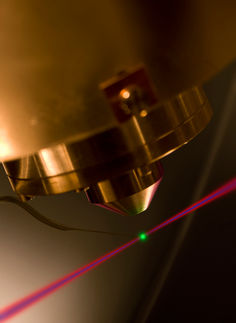
An international team of applied scientists from Harvard, Hamamatsu Photonics, and ETH Zürich have demonstrated compact, multibeam, and multi-wavelength lasers emitting in the invisible part of the light spectrum (infrared). By contrast, typical lasers emit a single light beam of a well-defined wavelength. The innovative multibeam lasers have potential use in applications related to remote chemical sensing pollution monitoring, optical wireless, and interferometry.
The research was led by postdoctoral researcher Nanfang Yu and Federico Capasso, Robert L. Wallace Professor of Applied Physics and Vinton Hayes Senior Research Fellow in Electrical Engineering, both at the Harvard School of Engineering and Applied Sciences (SEAS); Hirofumi Kan, General Manager of the Laser Group at Hamamatsu Photonics; and Jérôme Faist, Professor at ETH Zürich. The findings appeared online in the October 23 issue of Applied Physics Letters and will appear as a December 7 cover story.
"We have demonstrated devices that can create highly directional laser beams pointing in different directions either at the same or at different wavelengths," says Capasso. "This could have major implications for parallel high-throughput monitoring of multiple chemicals in the atmosphere or on the ground and be used, for example, for studying hazardous trace gases and aerosols, monitoring greenhouse gases, detecting chemical agents on the battlefield, and mapping biomass levels in forests."
The more versatile laser is a descendant of the quantum cascade laser (QCL), invented and first demonstrated by Capasso, Faist, and their collaborators at Bell Labs in 1994. Commercially available QCLs, made by stacking ultra-thin atomic layers of semiconductor materials on top of one another, can be custom designed to emit a well -defined infrared wavelength for a specific application or be made to emit simultaneously multiple wavelengths. To achieve multiple beams, the researchers patterned the laser facet with metallic structures that behave as highly directional antennas and then beam the light in different directions.
"Having multibeam and multi-wavelength options will provide unprecedented flexibility. The ability to emit multiple wavelengths is ideal for generating a quantitative map of the concentration of multiple chemicals in the atmosphere," explains Kan. "Profiles of these atmospheric components—as a function of altitude or location—are critically important for environmental monitoring, weather forecasting, and climate modeling."
Other news from the department science










Get the analytics and lab tech industry in your inbox
From now on, don't miss a thing: Our newsletter for analytics and lab technology brings you up to date every Tuesday. The latest industry news, product highlights and innovations - compact and easy to understand in your inbox. Researched by us so you don't have to.