11-14-2008: Jason Locklin and his colleagues from the University of Georgia have developed covalently bound polymer brushes that can bind metal ions when irradiated with UV light. The polymer brushes, containing spiropyran moieties, were synthesised using atom transfer radical polymerisation (ATRP).
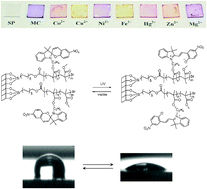
Spiropyrans are a group of photo-switchable organic molecules whose light induced cleavage of the spiro C-O bond results in switching between a colourless closed form and a strongly coloured open form. The binding is completely reversible, and can be switched using visible light. The binding also affords a drastic change in surface wettability and allows for switching between hydrophobic and hydrophilic states.

‘Developing sensors that are reversible and also extremely sensitive is one potential challenge. The binding has to be sufficiently weak to achieve reversibility. We plan to pursue improved techniques to push the detection limit of the sensors, possibly by using fluorescence as detection strategy,’ adds Locklin.

Original publication: Kristen Fries, Satyabrata Samanta, Sara Orski and Jason Locklin, Chem. Commun., 2008.
Additional Information

Facts, background information, dossiers
More about Royal Society of Chemistry
Contact
Royal Society of Chemistry (RSC)
Milton Road
CB4 0WF Cambridge
GROßBRITANNIEN
Phone
+441223420066
Fax
+441223423623
  • News

    Materials: The first graphene-based chiral sensor

    A reusable, natural and cheap amylose-functionalised graphene sensor was developed for highly sensitive and visual fluorescent chiral sensing by a team in China.The team found that the sensor’s detection sensitivity toward L-tryptophan was over 100 times higher than that of recently reporte ... more

    Non-invasive tool to diagnose endometriosis

    British scientists have used infrared spectroscopy to identify biochemical differences between endometrial tissue growing outside the uterus (ectopic) and the endometrial tissue of the uterus (eutopic). They also compared the results with tissue from endometriosis-free women (benign eut ... more

    Sensor to search for artery hardening compounds in blood

    A water-soluble zinc-based fluorescent sensor to detect pyrophosphate in blood has been developed by scientists from China. Pyrophosphate plays an important role in metabolic processes in the body but a lack of the compound can lead to Mönckeberg’s arteriosclerosis – calcium deposits in art ... more

More about University of Georgia
Contact
University of Georgia

30602 Athens, GA
USA
Phone
+1706542-3000
  • News

    UGA researchers achieve breakthrough in effort to develop tiny biological fuel cells

    University of Georgia researchers have developed a successful way to grow molecular wire brushes that conduct electrical charges, a first step in developing biological fuel cells that could power pacemakers, cochlear implants and prosthetic limbs. The journal Chemical Science calls the tech ... more

    Brushing up on sensors

    Jason Locklin and his colleagues from the University of Georgia have developed covalently bound polymer brushes that can bind metal ions when irradiated with UV light. The polymer brushes, containing spiropyran moieties, were synthesised using atom transfer radical polymerisation (ATRP). S ... more

Your browser is not current. Microsoft Internet Explorer 6.0 does not support some functions on Chemie.DE