Two world records at the FRM II: The world’s strongest and purest neutron beam
The world’s strongest neutron beam is produced by a scientific instrument at the research neutron source FRM II (Forschungs-Neutronenquelle Heinz Maier-Leibnitz) at the Technischen Universitaet Muenchen (TUM). But that is not all: During the long maintenance break in 2011, the instrument PGAA (Prompt Gamma Activation Analysis) was improved to give it the best ratio between usable neutrons and noisy background radiation worldwide. It is now possible to determine the elementary composition of even smallest samples in the milligram range. The instrument is operated by the Universities of Cologne (Germany) and Bern (Switzerland).
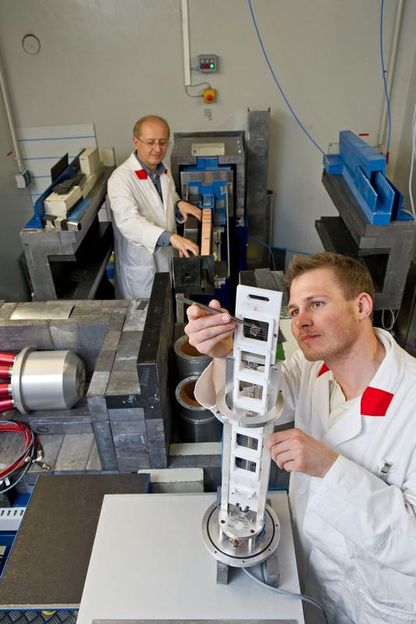
Insert of a sample for activation at the PGAA
Andreas Heddergott / TUM
Neutrons of the PGAA instrument activate the atoms of samples for which the precise composition is to be determined. The methodology is so extremely accurate that it is even possible to determine which mine delivered the ore used in a given antique coin. The PGAA generates up to 60 billion neutrons per square millimeter per second. That is an absolute world record among the scientific instruments of all research neutron sources. Other instruments produce only around half as many neutrons. “We require this high flux for small samples, for example,” explains Dr. Petra Kudejova, the responsible researcher at the PGAA. “These are samples of around one milligram.”
“We already had the highest neutrons flux, but also high levels of background radiation. That refers to radiation which derives not directly from the sample, but rather from scattered neutrons, which interfere with the measurements,” adds Dr. Zsolt Revay, also a researcher at the PGAA. “A low level of background radiation is a prerequisite for examining small samples that react only very weakly to neutrons.” Revay and his team used the long maintenance break at the FRM II in 2011 to improve and reconfigure the shielding of the instrument in such a way that the distracting background radiation is reduced to merely one tenth of its prior value.
The PGAA instrument is used primarily in the analysis of the elementary composition of objects. The measurement device can detect a single atom among one million other atoms. This made it possible, for example, to detect tiniest traces of harmful substances captured by an air filter. A magnetic meteorite sample weighing less than one milligram was also analyzed. The results of the analysis helped classify the meteorite. In this way, a theory making a meteorite impact in North America around 13,000 years ago responsible for the extinction of the mammoths could be verified.

Other news from the department science










Most read news




More news from our other portals
























See the theme worlds for related content
Topic world Elemental analysis
Elemental analysis is a fundamental pillar of chemical research and enables the quantitative determination of the basic elements contained in a compound. It gives insight into the atomic composition and provides essential information about the structure and properties of molecules.
Topic world Elemental analysis
Elemental analysis is a fundamental pillar of chemical research and enables the quantitative determination of the basic elements contained in a compound. It gives insight into the atomic composition and provides essential information about the structure and properties of molecules.