22 Current news of MIT
rssMIT team finds way to manipulate and measure magnetic particles without contact, potentially enabling multiple medical tests on a tiny device
27-09-2012
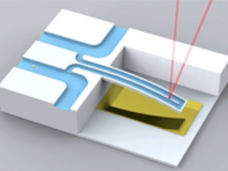
If you throw a ball underwater, you'll find that the smaller it is, the faster it moves: A larger cross-section greatly increases the water's resistance. Now, a team of MIT researchers has figured out a way to use this basic principle, on a microscopic scale, to carry out biomedical tests ...
Work by University of Michigan and MIT team yields new understanding of crucial reaction in the body and in CO2-scrubbing bacteria
28-03-2012
You see it listed on the side of your cereal box and your multivitamin bottle. It's vitamin B12, part of a nutritious diet like all those other vitamins and minerals. But when it gets inside your body, new research suggests, B12 turns into a gymnast.In a paper published in Nature, scientists ...
By using optical equipment in a totally unexpected way, MIT researchers have created an imaging system that makes light look slow
15-12-2011
MIT researchers have created a new imaging system that can acquire visual data at a rate of one trillion exposures per second. That’s fast enough to produce a slow-motion video of a burst of light traveling the length of a one-liter bottle, bouncing off the cap and reflecting back to the ...
New glass stamp may make cheaper, more precise biosensors
21-10-2011
Advances in microchip technology may someday enable clinicians to perform tests for hundreds of diseases — sifting out specific molecules, such as early stage cancer cells — from just one drop of blood. But fabricating such “lab-on-a-chip” designs — tiny, integrated diagonistic sensor arrays ...
New images improve resolution of measurements by a factor of 10,000 or more
27-04-2010
Wettability — the degree to which a liquid either spreads out over a surface or forms into droplets — is crucial to a wide variety of processes. It influences, for example, how easily a car's windshield fogs up, and also affects the functioning of advanced batteries and fuel-cell ...
New system could shed light on how cells control their growth
13-04-2010
Using a sensor that weighs cells with unprecedented precision, MIT and Harvard researchers have measured the rate at which single cells accumulate mass — a feat that could shed light on how cells control their growth and why those controls fail in cancer cells. The research team, led by ...
Could lead to even stronger synthetic materials
18-03-2010
Spiders and silkworms are masters of materials science, but scientists are finally catching up. Silks are among the toughest materials known, stronger and less brittle, pound for pound, than steel. Now scientists at MIT have unraveled some of their deepest secrets in research that could lead ...
MIT scientists record first microscopic images showing deadly effects of AMPs
16-03-2010
For two decades, scientists have been pursuing a potential new way to treat bacterial infections, using naturally occurring proteins known as antimicrobial peptides (AMPs). Now, MIT scientists have recorded the first microscopic images showing the deadly effects of AMPs, most of which kill by ...
Carbon nanotube sensor detects hydrogen peroxide emanating from a single living cell
09-03-2010
MIT chemical engineers have built a sensor array that, for the first time, can detect single molecules of hydrogen peroxide emanating from a single living cell. Hydrogen peroxide has long been known to damage cells and their DNA, but scientists have recently uncovered evidence that points to ...
09-02-2010
Cellular imaging offers a wealth of data about how cells respond to stimuli, but harnessing this technique to study biological systems is a daunting challenge. In a study published in Genome Research, researchers have developed a novel method of interpreting data from single-cell images to ...