Piece of cake: Arrays of long nanotubes may help measure terahertz laser power
terahertz radiation can penetrate numerous materials—plastic, clothing, paper and some biological tissues—making it an attractive candidate for applications such as concealed weapons detection, package inspection and imaging skin tumors. However, to date there is no standard method for measuring the absolute output power of terahertz lasers, one source of this type of radiation. Now, researchers at the National Institute of Standards and Technology (NIST) have found that dense arrays of extra-long carbon nanotubes absorb nearly all light of long wavelengths, and thus are promising coatings for prototype detectors intended to measure terahertz laser power.
The research is part of NIST's effort to develop the first reference standards for calibrating lasers that operate in the terahertz range, from the far infrared at wavelengths of 100 micrometers to the edge of the microwave band at 1 millimeter.
"There is no measurement traceability for absolute power for terahertz laser sources," NIST project leader John Lehman says. "We have customers asking for the calibrations. This coating looks viable for terahertz laser power detectors."
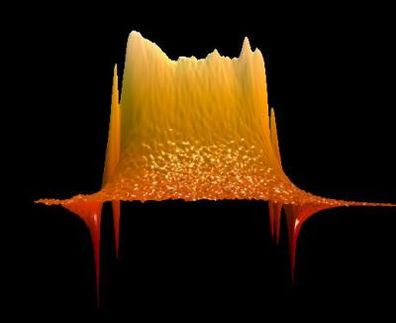
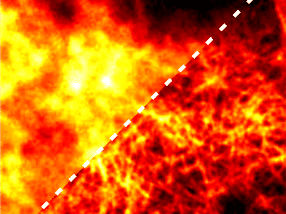
The coating, called a VANTA (vertically aligned carbon nanotube array), has several desirable properties. Most obviously, it is easy to handle. The nanotubes are tens of micrometers to over a millimeter long, so a dense layer is visible without a microscope. A chunk of VANTA can be cut, lifted, and carried like a piece of cake, making it easy to transfer from a silicon surface where the tubes are grown to a laser power detector.
Most importantly, the coating is very dark. The NIST team evaluated three VANTA samples with average lengths of 40 and 150 micrometers and 1.5 millimeters (mm) and found that longer tubes reflect less light. The 1.5 mm version reflects almost no light—just 1 percent at a wavelength of 394 micrometers. This result, the first-ever evaluation of a VANTA's reflectance at that terahertz wavelength, indicates that virtually all arriving laser light is absorbed, which would enable highly accurate measurements of laser power.
The 1.5 mm VANTA absorbs more light than comparable coatings such as gold black, but more work is needed to calculate uncertainties and determine effects of factors such as light angle. The project extends NIST's long history in laser power measurements and Lehman's recent advances in ultradark nanotube coatings.
VANTAs also have desirable thermal properties. NIST researchers found that the material absorbs and releases heat quickly compared to other black coatings, which will make the detectors more responsive and quicker to produce signals. Otherwise, a coating thick enough to absorb long wavelengths of light would not efficiently transmit heat to the detector.
In developing the capability for terahertz laser radiometry, NIST is building a terahertz laser designed for routine measurements and a detector called a thermopile to measure the laser's power. This simple detector design produces a voltage when heat is applied to a junction of two dissimilar metals. NIST researchers used the VANTA to coat a prototype thermopile. Further research is planned to design detectors that might be used as reference standards.
Other news from the department science











Get the analytics and lab tech industry in your inbox
From now on, don't miss a thing: Our newsletter for analytics and lab technology brings you up to date every Tuesday. The latest industry news, product highlights and innovations - compact and easy to understand in your inbox. Researched by us so you don't have to.