Visualising DNA sequences
A new, fast way to analyse DNA could be used to sequence the genomes of viruses and in the future help tackle genetic disorders such as schizophrenia and congenital heart defects.
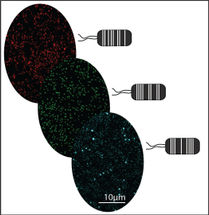
Robert Neely and colleagues have used a DNA methyltransferase enzyme to label the 5’-GCGC-3’ DNA sequences with a fluorescent marker. Immobilising and stretching the DNA on a surface then produces a unique and reproducible pattern when combined with the markers. The result is a ‘fluorocode’ - a simple description of the DNA sequence, which can be read and analyzed like a barcode. DNA barcodes using fluorescent tagging can be read quickly as labelled samples pass a detector, but Neely’s fluorocode gives significantly enhanced resolution and uses a much smaller number of DNA molecules.
Current DNA sequencing methods are able to sequence short regions of the genome. Regions that are either duplicated or deleted relative to a reference genome are an important cause of structural variation in the human genome with links to a variety of genetic disorders. But using current sequencing methods, studying these repeats is time consuming and labour intensive.
Original publication: Robert K. Neely, Peter Dedecker, Jun-ichi Hotta, Giedre, Urbanaviciute Saulius Klimašauskas and Johan Hofkens, Chemical Science., 2010.

Other news from the department science








Get the analytics and lab tech industry in your inbox
From now on, don't miss a thing: Our newsletter for analytics and lab technology brings you up to date every Tuesday. The latest industry news, product highlights and innovations - compact and easy to understand in your inbox. Researched by us so you don't have to.