Quantum computer calculates exact energy of molecular hydrogen
Groundbreaking approach could impact fields from cryptography to materials science
In an important first for a promising new technology, scientists have used a quantum computer to calculate the precise energy of molecular hydrogen. This groundbreaking approach to molecular simulations could have profound implications not just for quantum chemistry, but also for a range of fields from cryptography to materials science.
"One of the most important problems for many theoretical chemists is how to execute exact simulations of chemical systems," says author Alán Aspuru-Guzik, assistant professor of chemistry and chemical biology at Harvard University. "This is the first time that a quantum computer has been built to provide these precise calculations."
The work, described in Nature Chemistry, comes from a partnership between Aspuru-Guzik's team of theoretical chemists at Harvard and a group of experimental physicists led by Andrew White at the University of Queensland in Brisbane, Australia. Aspuru-Guzik's team coordinated experimental design and performed key calculations, while his partners in Australia assembled the physical "computer" and ran the experiments.
"We were the software guys," says Aspuru-Guzik, "and they were the hardware guys."
While modern supercomputers can perform approximate simulations of simple molecular systems, increasing the size of the system results in an exponential increase in computation time. Quantum computing has been heralded for its potential to solve certain types of problems that are impossible for conventional computers to crack.
Rather than using binary bits labeled as "zero" and "one" to encode data, as in a conventional computer, quantum computing stores information in qubits, which can represent both "zero" and "one" simultaneously. When a quantum computer is put to work on a problem, it considers all possible answers by simultaneously arranging its qubits into every combination of "zeroes" and "ones."
Since one sequence of qubits can represent many different numbers, a quantum computer would make far fewer computations than a conventional one in solving some problems. After the computer's work is done, a measurement of its qubits provides the answer.
"Because classical computers don't scale efficiently, if you simulate anything larger than four or five atoms -- for example, a chemical reaction, or even a moderately complex molecule -- it becomes an intractable problem very quickly," says author James Whitfield, research assistant in chemistry and chemical biology at Harvard. "Approximate computations of such systems are usually the best chemists can do."
Aspuru-Guzik and his colleagues confronted this problem with a conceptually elegant idea.
"If it is computationally too complex to simulate a quantum system using a classical computer," he says, "why not simulate quantum systems with another quantum system?"
Such an approach could, in theory, result in highly precise calculations while using a fraction the resources of conventional computing.
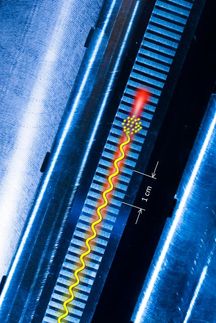
While a number of other physical systems could serve as a computer framework, Aspuru-Guzik's colleagues in Australia used the information encoded in two entangled photons to conduct their hydrogen molecule simulations. Each calculated energy level was the result of 20 such quantum measurements, resulting in a highly precise measurement of each geometric state of molecular hydrogen.
"This approach to computation represents an entirely new way of providing exact solutions to a range of problems for which the conventional wisdom is that approximation is the only possibility," says Aspuru-Guzik.
Ultimately, the same quantum computer that could transform Internet cryptography could also calculate the lowest energy conformations of molecules as complex as cholesterol.
Other news from the department science










Get the analytics and lab tech industry in your inbox
From now on, don't miss a thing: Our newsletter for analytics and lab technology brings you up to date every Tuesday. The latest industry news, product highlights and innovations - compact and easy to understand in your inbox. Researched by us so you don't have to.