2D nanostructure altered by change in temperature.

05-11-2009: European collaboration of scientists creates an H-bonded 2D network, in which changing temperature changes the 2D conformation.
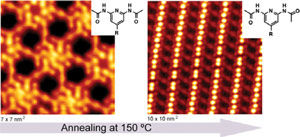
Davide Bonifazi has completed research both at the University of Namur, Brussels, and the University of Trieste, Italy and has collaborated with Meike Stöhr from the University of Basel, Switzerland and colleagues from the three universities. This collaboration reports the formation of an H-bonded porous hexagonal network which evolves into a close-packed rhombic pattern after thermally-induced trans-cis inversion of the conformation of the amidic groups.

‘We have shown using scanning tunnelling microscopy (STM) that 8-conjugated molecules bearing complementary H-bonding sites can self-organise into complex 2D porous networks on surfaces' Bonifazi explains. 'It is possible to thermally induce a phase transition (from a porous hexagonal to a rhombic close-packed 2D assembly) by exploiting conformational degrees of freedom.'

‘The need for highly organised materials at the molecular level has become increasingly apparent from basic science and applied technologies’ says Bonfazi. He explains that 'the current state of research in this field is still far from being a sophisticated and targeted "bottom-up" approach towards the fabrication of predictable supramolecular entities, usable in real-world applications.’

The group is planning to develop other networks which can be tuned in size and shape using external stimuli, by selecting appropriate spacing groups and recognition moieties.

Original article: Matena et al.; "Conformation-controlled networking of H-bonded assemblies on surfaces"; Chem. Commun. 2009
Contact / Request information

Request further information free of charge:

Additional Information

Facts, background information, dossiers
More about Royal Society of Chemistry
Contact
Royal Society of Chemistry (RSC)
Milton Road
CB4 0WF Cambridge
GROßBRITANNIEN
Phone
+441223420066
Fax
+441223423623
  • News

    Materials: The first graphene-based chiral sensor

    A reusable, natural and cheap amylose-functionalised graphene sensor was developed for highly sensitive and visual fluorescent chiral sensing by a team in China.The team found that the sensor’s detection sensitivity toward L-tryptophan was over 100 times higher than that of recently reporte ... more

    Non-invasive tool to diagnose endometriosis

    British scientists have used infrared spectroscopy to identify biochemical differences between endometrial tissue growing outside the uterus (ectopic) and the endometrial tissue of the uterus (eutopic). They also compared the results with tissue from endometriosis-free women (benign eut ... more

    Sensor to search for artery hardening compounds in blood

    A water-soluble zinc-based fluorescent sensor to detect pyrophosphate in blood has been developed by scientists from China. Pyrophosphate plays an important role in metabolic processes in the body but a lack of the compound can lead to Mönckeberg’s arteriosclerosis – calcium deposits in art ... more

More about Universität Basel
Contact
Universität Basel
Petersplatz 1
4003 Basel
SCHWEIZ
Phone
+41612671298
Fax
+41612673013
  • News

    Video reveals wave character of particles

    Quantum theory describes the world of atoms very precisely. Still, it defies our macroscopic conception of everyday's world due to its many anti-intuitive predictions. The wave-particle dualism probably is the best known example and means that matter may spread and interfere like waves. Now ... more

    Wave Motion - New Compounds for Molecule Interferometry Experiments

    When waves meet, a new single wave is created. This phenomenon is well understood for mechanical waves such as sound, and electro-magnetic waves such as light, and the "interference" of light waves is applied in astronomy, fiber optics, and oceanography. The observation that even individual ... more

    Clicking Tc-99m SPECT Probes Together

    Radioactively labeled compounds are important for use as imaging probes or radiotherapeutic agents. Most radioisotopes with suitable decay properties are transition metals or elements with metallic character. Therefore, bifunctional chelators are required for stable tethering of a given rad ... more

Your browser is not current. Microsoft Internet Explorer 6.0 does not support some functions on Chemie.DE